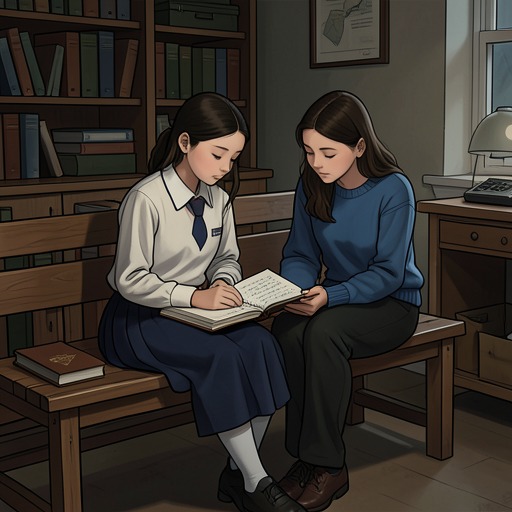
Seizo Naemura
The Final CurtainSeizo Naemura is Hiromi Asai’s junior-high homeroom teacher, confidant, and later lover, whose disappearance links the buried history of Hiromi’s family to the present murder investigation. First remembered as a reliable adult who continued to visit after Hiromi’s mother left, he becomes a private presence in her adolescence and then an accomplice in concealing her father’s death. The investigation’s question of where he went is answered in a confession from Tadao Asai: Naemura had been strangled and his body hidden.
Identity and Early Role
Naemura taught Hiromi and Michiko Oshitani when they were in their second year of junior high school. After Atsuko Asai abruptly left the family, he began stopping by the Asai home to see how things were. Hiromi remembered him as more than forty, yet youthful in face and physique, and as someone who spoke and carried himself like a much younger man. His university education had left him speaking Japanese without an accent, a quality Hiromi particularly admired. In a period when her home life had become uncertain and classmates would soon mock her, his attention offered a measure of calm.
His connection to the girls did not end with the school year. He continued visiting Hiromi after she transferred to another junior high school, listening sympathetically as she confided her anxieties. When Michiko later asked Hiromi whether she and Naemura exchanged New Year’s cards, the question exposed how thoroughly he had vanished from his old community: Michiko explained that she had once tried to contact him for a class reunion, but none of their classmates knew where he lived. The contrast between his earlier, conspicuous care and his later absence gives the disappearance its particular weight.
From Teacher to Lover
Hiromi’s attachment to Naemura changed over time. As a junior-high student she looked up to him as a teacher; after entering high school, she began to regard him as a man. She eagerly anticipated his visits and worried about what to wear when he came. Their relationship was not physical until shortly before her high-school graduation, a boundary the narrative makes explicit even as it shows that their emotional intimacy had developed over years of visits and confidence.
The relationship’s transition is anchored in a specific memory: the day after Hiromi graduated, she and Naemura went to Lake Biwa to mark the occasion. By then her plan to move to Tokyo in April had been settled, and their relationship had recently become physical. Hiromi recalls the lakeside scene not as a fantasy but as something witnessed firsthand. Its placement amid her unease about whether Motoko Yoshino has guessed the truth underlines the discrepancy between the version of her life she has tried to keep from others and the private history she carries.
Concealment and Disappearance
Naemura’s visits also placed him in the aftermath of the Asai family’s collapse. After Tadao died, Hiromi was sent temporarily to a children’s shelter. She begged Naemura not to tell her friends that she and her father had fled in the night or that Tadao was dead—or, if he had to disclose the death, to hide how it happened. Naemura promised to protect the secret and said he would find a way to keep the details from people at school. His willingness to do so helps explain why the account preserved at Biwa Gakuen Orphanage was not a straightforward official record.
Years later, Kyoichiro Kaga points out that the orphanage’s version of Tadao’s death—suicide by jumping from a large building—appears to rest on accounts supplied by Hiromi and Naemura, rather than on official documentation. Kaga suspects that Tadao died in a different way and place. Hiromi confirms the significance of the teacher’s role by saying that her homeroom teacher worked hard to keep news of her father’s death under wraps; she identifies Naemura when Kaga names him. The false account is therefore not simply a gap in the record: it is evidence of Naemura’s involvement in maintaining the silence around Hiromi’s past.
That silence becomes a police lead when investigators connect Hiromi and Michiko to a former teacher who is now missing. Shiga Prefectural Police find that Naemura’s residence certificate at his last known address was canceled ex officio fifteen years earlier. He is the only missing man of an appropriate age they identify, prompting Shuhei Matsumiya and Sakagami to travel to Shiga. At the school, Motoko Yoshino remembers Naemura as an unusually frequent visitor, someone whose concern for his former students had made the adults grateful. Her recollection confirms the pattern of care, while doing nothing to explain why he disappeared.
Death and Narrative Significance
The answer comes through Tadao’s confession to Hiromi. Tadao says he had something to tell her about Naemura and asks whether she remembers him; then he asks whether she had been seeing the teacher. Hiromi recognizes the moment he is recalling: the morning after her last phone call from Naemura. She infers that Naemura must have followed her to a hotel, believing she was meeting another lover, and watched through the night to find out who the man was.
Tadao recounts that he told Naemura he would explain what was happening, then led him toward the hotel car park. As they walked, Tadao dropped behind, took off his necktie, and strangled Naemura from behind. He describes Naemura as weak and says the early hour meant no one else was around. He then stashed the body in the bed of a truck in the parking lot, intending to dispose of it far away; the truck and rental-car details thus belong to the logistics of hiding the killing. Tadao calls Michiko Oshitani the second person he strangled, placing Naemura’s death first in the sequence of murders he admits to.
Naemura’s story is structured around a disturbing reversal. The adult who offered Hiromi sheltering attention and promised to protect her father’s secret is himself drawn into the concealed history that her childhood records obscure. His disappearance initially appears as a blank in classmates’ memories and a canceled residence record; the investigation gradually makes that blank legible as the consequence of Tadao’s violence. At the same time, the account leaves Naemura’s actions morally complicated: the evidence establishes his care for Hiromi, his later intimacy with her, and his promise of secrecy, but it does not disclose everything he knew or intended. His importance lies in how those strands converge—teacher, lover, keeper of a family secret, and missing victim—turning a private history into a key to the case.